
“What we needed from Abunda was an objective eye to make sure we made the right call.”
Fidelity Weston, Romshed Farm
Intro
Fidelity Weston of Romshed Farm and Andrew Murison of Broxham Farm approached Abunda at a crucial point of gradual succession.
The two Kent farms were being run collaboratively through a shared system, providing a regenerative livestock enterprise across more than 600 acres. Both Landholders wanted the farms to continue producing high-welfare, nutrient-dense food while improving soil health, biodiversity and educational access. However, they also wanted to step back from day-to-day farming.
This was not simply a search for a tenant or replacement operator. It was a complex, personal and commercially important decision. The Landholders needed the right long-term partner: someone with the skills, values and financial resilience to take the collaborative enterprise forward.
About the farms
Romshed Farm, near Underriver, Sevenoaks, and Broxham Farm, near Edenbridge, together offered around 600 acres, including permanent pasture, herbal leys, livestock infrastructure, machinery and existing sales routes.
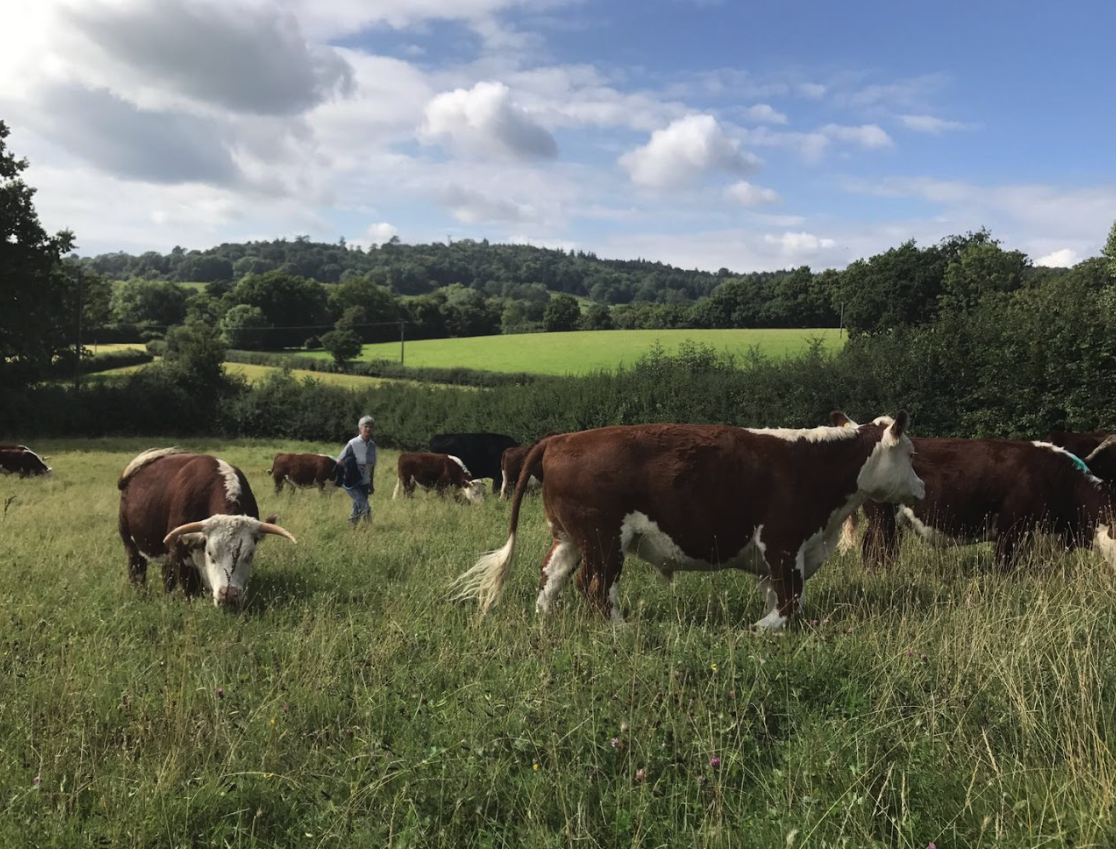
The existing enterprises included breeding, rearing and finishing cattle and sheep, with a Hereford suckler herd of around 30 animals plus followers, and approximately 170 ewes. The farms were already operating with low-input regenerative principles, including PFLA and organic certification in place.
There was also scope to build on the system through complementary enterprises such as agroforestry, pastured poultry or market gardening. However, the economics showed that without sufficient scale and the right operating structure, the farms would struggle to thrive.
The Landholders’ situation
Fidelity had been trying for several years to find a way of stepping back while keeping the farm’s values intact. Previous attempts had not created enough independence: the enterprise still required her oversight, and she remained responsible for many day-to-day decisions.
Andrew’s challenge was slightly different. Broxham had been part of a wider collaborative farming arrangement, but once that lost scale, the economics became harder and he was increasingly drawn into practical day-to-day work. The long-term aim was still clear: to farm in a way that supported soils, biodiversity and the wider landscape.
The Landholders already had several local possibilities, but they wanted an independent process to help assess the options fairly. As Fidelity put it:
“What we needed from Abunda was an objective eye to make sure we made the right call. I didn’t feel confident doing it on our own.”
She added that the situation was complicated because it involved two farms, local relationships, and the need to say no to people they knew. Abunda’s role was to bring clarity, confidence and structure to that decision.
Abunda’s role
Abunda began by understanding the two farms both individually and together: their values, economics, land use, practical constraints and desired future.
The process included inviting expressions of interest, interviewing candidates and asking shortlisted parties to set out their business plans and proposals using Abunda’s templates. This helped the Landholders compare candidates on more than enthusiasm, and allowed some parties to self-select out when the opportunity was not right for them.
Fidelity described the process as “logical and sensible”, noting that asking candidates to prepare an initial proposal helped “kick it off” and meant everything “followed through quite neatly”.
A collaborative Whiteboard Session was then held with shortlisted parties, allowing the Landholders, Landseekers and Abunda to explore the farm plan together before final proposals were submitted.
Throughout, Abunda helped assess alignment across five areas: shared vision, values, people dynamics, economic realism and suitable legal structures. For Andrew, this people-focused approach was central:
“The people dynamics was the clincher.”
He also described Abunda’s process as “not just about mechanics or knowledge”, but about people and teams working together.
The Outcome
Fidelity and Andrew both chose the same farming family to take over Romshed Farm and Broxham Farm through separate agreements.
One arrangement was structured as a Farm Business Tenancy and the other as a Contract Farming Agreement, reflecting the different needs of each farm. This gave the incoming farmers enough scale to build a more viable business, while giving both Landholders confidence that the farms’ regenerative and environmental aims would continue.
For Fidelity, the outcome meant being able to step back from daily responsibility while maintaining a constructive relationship with the incoming farmer. Early on, she described the change as “really great”, saying she finally had time to get some organisation back into life on the farm.
For Andrew, the process created a clearer long-term trajectory for Broxham, with a suitable partner and agreement in place.
Most importantly, both farms were able to move into their next chapter with continuity: productive farming, environmental ambition and long-term stewardship held together.
Testimonial Summary
Fidelity summarised the value of Abunda as providing the independent judgement and confidence needed to make a difficult decision:
“What we needed from Abunda was an objective eye to make sure we made the right decision.”
Andrew described the process as:
“Efficient, effective and enjoyable.”
Together, their reflections show the value of a process that did not rush to a match, but helped the right relationship emerge with clarity, structure and confidence.